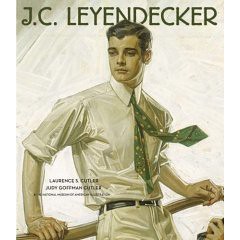
 After reading Hide/Seek, I became interested in illustrator J. C. (Joseph Christian) Leyendecker, so I looked around for a good book to read about him. Eventually, I settled on J.C. Leyendecker (2008) by Laurence S. Cutler, Judy Goffman Cutler, and the National Museum of American Illustration. This book is a wonderful collection of Leyendecker’s illustrations accompanied by excellent essays about the Golden Age of American Illustration, Leyendecker’s life, and Leyendecker’s distinctive work. I enjoyed reading (and looking at) it!
Leyendecker’s importance in the history of early twentieth-century American illustration can’t be overstated. He produced over 300 covers for The Saturday Evening Post and was one of, if not the, most popular advertising illustrators of the 1920s and 30s. His images became iconographic representations of sophisticated, urban American chic.
Leyendecker was also gay, and his illustrations often incorporate homoerotic imagery. I find the way this book discusses this element of his art to be very interesting:
Knowing that revealing his secret would threaten his popularity and success, Joe never came out of the closet…. He also attempted to conceal his sexual orientation in his work, which was often characterized by heterosexual female adoration for handsome males depicted in overtly erotic poses. Yet, ironically, he was the most manifest homosexual artist of the early twentieth century–a virtual hero–as his work clearly demonstrates to today’s enlightened audience.
To create such delicious illustrations, he smoothed oils on models’ muscles, enhancing the light reflecting on male surfaces he admired most: one model said that Joe always painted him in a darkened studio, with only candlelight highlighting the erotic qualities of his gleaming form. The gay subculture saw the irony in his work and appreciated the erotic images he lavished upon the world.
These homoerotic images appealed to heterosexual viewers as well, however. In a subtle subversion of heterosexual mores, unattractive men turned to them in their quest to be more appealing through the products being advertised. Sportsmen never saw the football players’ images as anything but manly, for they reveled in the enthusiasm created among the fans. College men, particularly Ivy Leaguers and prep school chums, were proud that their alma maters were highlighted. And most of all, women were drawn to Joe’s images, dreaming of intimacies with men who possessed “The Leyendecker Look.”
While Leyendecker was not publicly out, he did have a partner, Charles A. Beach (1886-1952), whose image is sometimes featured in Leyendecker’s work, as in this illustration, which is included in the Hide/Seek exhibit:

Beach is on the left. Beach is also the model featured in the book’s cover illustration.
 PJ and I missed the Hide/Seek: Difference and Desire in American Portraiture exhibit
 Sweet Like Sugar centers on Benji Steiner, a gay advertising executive who has started his own small company in the same shopping center as a rabbi’s Jewish bookstore. Benji is Jewish but has lost touch with his faith. He still practices a handful of Jewish observances, but in general he doesn’t really connect to his Jewishness any longer.
 While recuperating from (very) minor surgery last week, I read Kelly Kathleen Ferguson’s My Life as Laura: How I Searched for Laura Ingalls Wilder and Found Myself, which was just published by Press 53. Hilariously realistic and sincere, it was a great book to read while stuck at home and feeling kind of miserable. I thoroughly enjoyed it.
 I’ve been sick the past couple of days and, apart from a day trip over to Dayton to watch a women’s regional semi-final game between UT and OSU, I’ve pretty much just wanted to stay in bed. Fortunately, while PJ and I were in Columbus earlier this week I picked up a copy of Star Wars: Death Star, which I’ve been wanting to read since it first came out in 2007.
 I’ve just started reading Laura Fredricks’s The Ask: How to Ask for Support for Your Nonprofit Cause, Creative Project, or Business Venture for work. Whether I like it or not, a large part of my job is fundraising, and my success or failure will largely be measured by my ability to raise money for my college.
 This past summer I read Regina Jeffers’s Captain Wentworth’s Persuasion, a retelling of Jane Austen’s Persuasion from Wentworth’s perspective. Originally published as Wayward Love: Captain Frederick Wentworth’s Story in 2009, this novel is a welcome addition to the ever-increasing number of Jane Austen rewrites, continuations, and adaptations.
 I’m a total nut for (some) rewrites of Jane Austen’s novels. As I’ve blogged about before, I love
  Frederick Wentworth, Captain is a two-volume novel by Susan Kaye that relates the events of Jane Austen’s Persuasion from Captain Wentworth’s point of view. The first volume, None but You, came out from

![IMG_8341[1]](https://live.staticflickr.com/8644/27753735444_2ca20d29d0_s.jpg "IMG_8341[1]")
 This Gaudy Gilded Stage